Staggering Data that Should Make the Political Class Reconsider Its Tribal Messaging and Strategies

Ever wonder what the consequences of long-term political warfare messaging are for voters? This article goes beyond typical polling data and looks at the expectations and viability of national unity over time. And what some voters are doing about it. The numbers that follow come from a recent John Zogby Strategies national survey of 1,000 likely voters, conducted May 20-21.
I recently asked a question that most pollsters avoid. This question gets to the core of whether Americans are still in this together. The results are shocking and almost absent from mainstream political coverage.
The exact wording of last week’s poll question was: “In your view, do you believe the United States will remain united in five years?” Just 55% of voters say yes.
To obtain greater depth, I followed it up with a time series.
“In your view, do you believe the United States will remain united in ten years? To which 51% tell us yes.
And then once more regarding twenty years from now, 48% say yes.
50% is a key psychological barrier, and less than half of likely voters believe the U.S. will still be united two decades from now. Beyond these topline data points, that movement from 55 to 51 to 48 is revealing as a directional indicator, and speaks volumes about the exact moment we’re in regarding the Hyperpolarization Age (2004-Present). It’s revealing because with each additional time increment, voters’ confidence in our ability to maintain national unity withers. It gives us a greater understanding of our destiny than we’re typically accustomed to with two-dimensional questions such as, Is the country headed in the right direction or off on the wrong track? Or even the classic approval/disapproval temperature check pollsters frequently release. And even though Substack readers of the Independent Pollster are accustomed to seeing numbers such as President Donald Trump’s underwater approval rating in the minus 30s among unaffiliated voters, the unity question, as it has been framed over time, offers us a much clearer picture of where things are going as we approach our 250th anniversary.
A breakdown of party identification is equally powerful. And notice, only on the surface does it reflect our current hyper-partisan environment. Those who say yes they believe the U.S. will remain united in five years include 40% of Democrats, 75% of Republicans, and 49% of Independents.
In ten years, it’s 40% of Democrats, 71% of Republicans, and 48% of Independents.
In twenty years: 40% of Democrats, 63% of Republicans, and 39% of Independents. Again, partisanship is a factor, as seen with the consistency among Democrats. But the sharp fall among Republicans is particularly alarming. This is the party that had a sweeping victory in 2024. And they lose 12 percentage points of confidence in national unity over a twenty-year horizon. Zeroing in on Independents, 39% see an America united twenty years, below both official parties. It’s a number that jumps out as they’re the quintessential swing bloc in the electorate.
While I wish I’d thought to ask this question at least a few years ago to see any trend line, the reality is the snapshot presented here itself is powerful enough to stand alone. A baseline this stark doesn’t need a trend line to grasp the issue at hand.
Reading up to this point, it’s clear the headline contains the appropriate data in the article to back up the claim. But the next question goes beyond forecasting expectations and looks at action, asking voters if they currently have plans to leave the U.S.
Overall, 9% say yes, they have plans to leave the country. Skeptics will understandably argue that talk is cheap and that most won’t follow through. But I’d push back on that because the fact that nearly one out of every ten is telling this pollster they’re considering running for the national exit signs is alarming in itself. Moreover, the number is virtually identical across party lines with 11% of Democrats, 10% of Republicans. Those 10% of Republicans are most likely not MAGA. But the fact remains inescapable that one out of every ten voters aspires to leave.
Then there are the two sub-groups which really drive the point home. And I’ll say it again. These are numbers our Political Class should be considering, but aren’t because they’re too busy constructing tactics to win the next election. And most certainly not strategizing how to preserve our country and national community.
20% of Parents with young children say they plan to leave the country. My read of the data tells me this is not selfishness but, instead, the self-preservation mode a parent naturally has for their little ones amid an intense environment. To put it bluntly, it’s a deeply considered judgment that America may not be the best place to raise the next generation.
And then there are Veterans. Twenty percent of people who took an oath to protect and serve, who put their lives on the line for this country, are telling us they’re considering leaving it behind. After all, this is the cohort with arguably the most skin in the game, yet one out of every five have plans to go abroad. I wouldn’t label these voters traitors or chickens. Instead, I see something that’s torturing them. A country that left them behind first.
And what about our youth?
Those ages 18 to 29 reach 25%. A quarter of the youngest voting cohort is considering leaving the country. To get a read on what’s going on here, this cohort is looking ahead to what America will be based on their judgment today and a significant portion of them are saying they’re devising an exit strategy. They came of age during the 2008 financial crisis, only to stumble into the student debt crisis, a housing market they cannot enter, and two of the most divisive elections in modern history. Can we blame their pessimism? Is it fair to label them irrational? Or are they taking a close look at the evidence based on all that they know?
I can imagine some of the reactions voters might have upon reading this article. Charges of these Americans as traitors, doubters, haters, etc. But an even closer look at the data reveals it’s deeper than that.
I also asked respondents in this recent poll to describe their ideal community. 722 out of 1,000 people gave answers. Naturally, I expected political tribalism to dominate these open-ended responses because that’s the defining feature of our political landscape and that’s the story of the day. But what I found was almost the opposite.
When coded across 14 categories, 722 open-ended responses to the question “describe your ideal community” produced the following distribution:
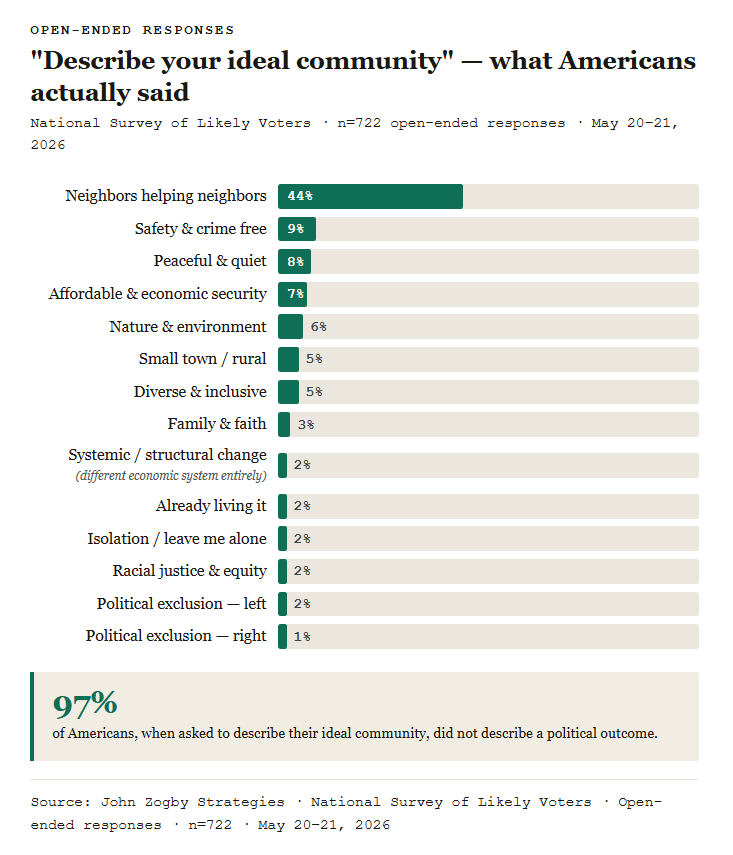
Respondents whose ideal community is defined by removing the other side accounts for just 3% of 722 responses. Yet the national media covers America as a country defined by political tribalism. This poll shows 97% of Americans, when asked what they actually want, don’t describe a political outcome.
What they do describe in the 300+ answers from the largest category includes neighbors helping neighbors, block parties, neighbors who wave, a community where everyone knows each other.
So we have a country where less than half believe it will be united in twenty years, one in ten wants to leave, and yet when you ask what voters want, it is little wonder it’s community with mutual care. Which means Americans haven’t stopped wanting community. They’ve stopped believing the national political system fosters it, which leads me to conclude that the pessimism stems from our political landscape, driven by our national leadership.
And the lesson for our national leadership, more specifically, the political class, is this: winning an election is not an end in itself; building trust is. And if recent election history tells us anything, it’s that while you can win a majority, you can’t effectively govern a country where half the people don’t believe it will hold together twenty years from now.
In the final analysis, the lesson here is that voters who lack the expectation that this country will remain united are the first warning sign. The second warning sign is the high number of voters who say they plan to leave, and they do because the national drama is filtering down to the community level. Lastly, the ideal community data is actually the most hopeful thing I’ve found over many months of polling because what people are describing includes neighbors helping neighbors, small towns, block parties, people watching out for each other. It means the intense longing for community already exists beneath the political warfare messaging. The question isn’t whether Americans know how to build community. It’s in our DNA, as Alexis de Tocqueville observed 200 years ago. The question is whether the political system can get out of the way long enough to let it happen once again.